Programming Smart Cooling Systems for Smarter Data Centers

PROGRAM.

Whaley’s AI-optimized chillers use advanced programming, automation, and data-driven control to deliver precision cooling for the world’s most demanding AI environments.

tank-control-touchscreen-group

Seamless System Integration

Seamless Integration into Any AI Data Center Stack Your cooling system shouldn’t be an island. Whaley chillers are designed from day one to live natively inside the modern data-center control plane.
- Depending on you application there are many communication protocols that could be utilized
- Real-time publishing of 200+ operating points (PUE contribution, coolant ΔT, kW cooled, instantaneous COP, compressor run hours, predictive alerts, etc.)
- Redundant Ethernet ports with RSTP/MRP ring support for zero-downtime networks
- Secure remote access via VPN or zero-trust tunnels for Whaley factory engineers (with customer approval only)
The result? Your operations team sees cooling as just another rack in the DCIM dashboard — with full fault propagation, trending, and automated ticketing. No custom middleware. No proprietary gateways. Just plug, authenticate, and go.

Whaley doesn’t just connect to your BMS — we become a fully instrumented, controllable part of your infrastructure fabric.

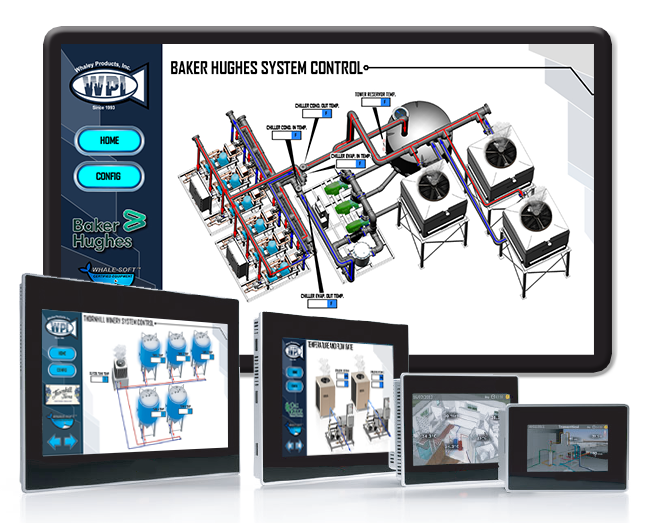
Programming Smart Cooling Systems

Whaley AI Data Center Cooling Systems Engineered for the extreme power densities of modern AI workloads. Our high-performance chillers and liquid-cooling solutions deliver 99.999% uptime with industrial-grade components proven in the world’s toughest environments.
Built-in adaptive control algorithms and real-time predictive analytics continuously optimize cooling capacity, flow rates, and energy use — reducing PUE while eliminating thermal throttling of your GPUs. Your AI cluster runs at full clock speed, 24/7, without compromise.
Whaley doesn’t just cool your servers. We keep your AI infrastructure running at peak performance, today and at tomorrow’s 200 kW+ rack densities.

Through remote connectivity and machine-assisted programming, Whaley systems evolve over time. Performance data is continuously collected and analyzed, allowing operators to fine-tune control parameters, schedule maintenance proactively, and identify inefficiencies before they impact uptime. This level of programmable intelligence transforms cooling from a static utility into a dynamic, learning component of the data center — one that actively contributes to reliability, performance, and efficiency.